
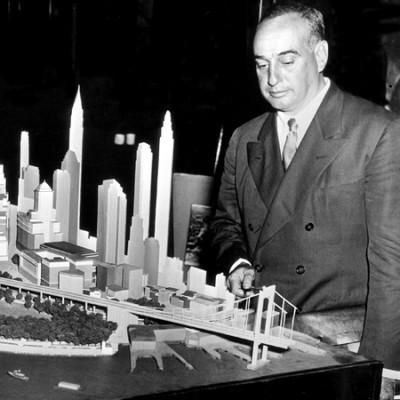
Remember when everybody thought it would be a good idea to bulldoze cities and replace them with parking lots, “parks”, highways and high-rises? I don’t, but apparently that was a part of modernism and kind of a thing in the 1950’s.
We can see modernism’s byproducts today and they’re pretty unfortunate. When a couple says they want to buy a “prewar” or “new development”, they are actually saying they don’t want to buy one of those mid-century debacles.
Why are they so bad? Well, they weren’t really built for, you know, actual people. Instead, planners, architects, and developers built them for statistics.
Sticking people in a tower frees up space below for parking or a park. This makes a lot of sense on paper; people have more space, air, and light. The city gets cleaner and more logically laid out as well. But none of this worked because of a single simple fact. People want to know what’s going on.
They want to know what’s going on with their surroundings, be that a neighborhood or building, and a high-rise makes this knowing this extremely difficult. Suburbs seem to make knowing this easier, with all that nature and space, but consider the commute. Increasing traffic has made commutes longer, more obnoxious, and something from which the younger generation rightly rebels.
This leaves a typical coastal city with just a few livable neighborhoods, the old ones near the city center, and they costs a pretty penny.
The solution might seem simple; just build more West Villages and Beacon Hills with a dollop of light rail in between. The problem is, you can’t, and not just because of money.
The government has, with mostly good intentions, enacted a host of codes and rules that make recreating small neighborhoods simply impossible. Don’t get me wrong; today’s apartments are more energy efficient, handicapped-accessible, and less fire prone than ever. But each of those improvements had a price beyond cash.
A green building will have thicker walls and thicker windows. This may not sound like much until you realize that you can’t hear anything outside and those the windows are just fashioned to look like something a pilgrim hacked together; in reality they are hermetically sealed triple-layer plastic and steel clad factory creations. What’s that little vertical seam along the bricks? In other words, you don’t know what’s going on.
This applies to the all those extra wide doorways and extra gently slopped staircases that modern rules necessitate. As much as they improve the building’s safety and functionality, they take the building ever farther away from a human scale. More often than not, the final product just feels a little bit…wrong.
Building a building that partially avoids this fate is possible but frightfully expensive, since components that both look hand-made and perform to modern standards require quite a bit of labor. This applies to cars as well.
Yes, we’ve finally gotten to cars, specifically air cooled Porsches. Why have they gotten so expensive? Some say it’s because of a general sports car bubble, but instead people have realized air-cooled 911’s are an automotive West Village.
You know the deal. The steering’s communicative. The harder you press on the throttle, the faster you go. Things are simple. You can see outside. What looks like leather is leather and what looks like plastic is plastic. Everything makes sense because you’re in touch with the car. Everyone’s known this about old 911’s; the difference now is that everyone knows those traits aren’t coming back. Ever.
Although I risk sounding like an anti-government crank, the truth is that regulations really have constrained the supply of the kinds of cars and houses that just feel right.
The good news is we don’t have to eliminate all rules, just loosen them a bit and hope automakers take advantage. Cars perform better in crashes because of thicker pillars and stronger steel. Catalytic converters don’t sap power like they used to and engines are just thermodynamically better, even without forced induction. Why not just loosen the rules to say, mid-00’s levels and then tighten them at the pace of natural innovation?
What might such a regulatory relaxation look like? CAFE standards would be less tied to a vehicle’s footprint and have separate categories based on a car’s purpose, as in relaxed standards for convertibles, wagons, SUVs, and sports cars. This alone would go a long way towards preventing automotive entropy and the Honda CR-V-ification. Certain models, like the Crown Vic or Wrangler, could receive some sort of vehicular landmark status too.
None of those proposals would turn the air brown or submerge the east coast, instead they would treat special cars the way we treat special buildings. Since cars have a harder time lasting forever(something about moving I guess), the rules just apply to cars in continuous production. The result: you don’t have to be rich enough to live in the West Village to drive one.
 Car and Other